Ecommerce Fulfillment Solutions: How Growing Brands Build Faster, More Reliable Operations

Growing brands need ecommerce fulfillment solutions that improve speed without sacrificing accuracy, visibility, or compliance. The right operating model combines disciplined warehouse execution, scalable 3PL fulfillment services, and technology that connects inventory, orders, transportation, and customer updates.
What should growing brands expect from ecommerce fulfillment?
Effective ecommerce fulfillment starts with repeatable processes across receiving, storage, picking, packing, shipping, and returns. Third party logistics providers should give brands clear service-level expectations, accurate inventory records, and flexible capacity across channels. Choose a partner that can support growth without adding unnecessary handoffs or operational complexity.
Same-day and next-day fulfillment cutoffs
Marketplace-compliant labeling and packaging
Lot, batch, and expiration tracking
Returns processing and restocking
Real-time inventory and order visibility
How does technology improve inventory management for ecommerce?
A modern warehouse management system creates one source of truth for every SKU, location, order, and movement. FlowOps by Lanta is an operator-built platform developed inside an active logistics operation. It combines logistics software with real-time visibility across warehouse and transportation workflows, helping teams identify exceptions before they become customer problems.
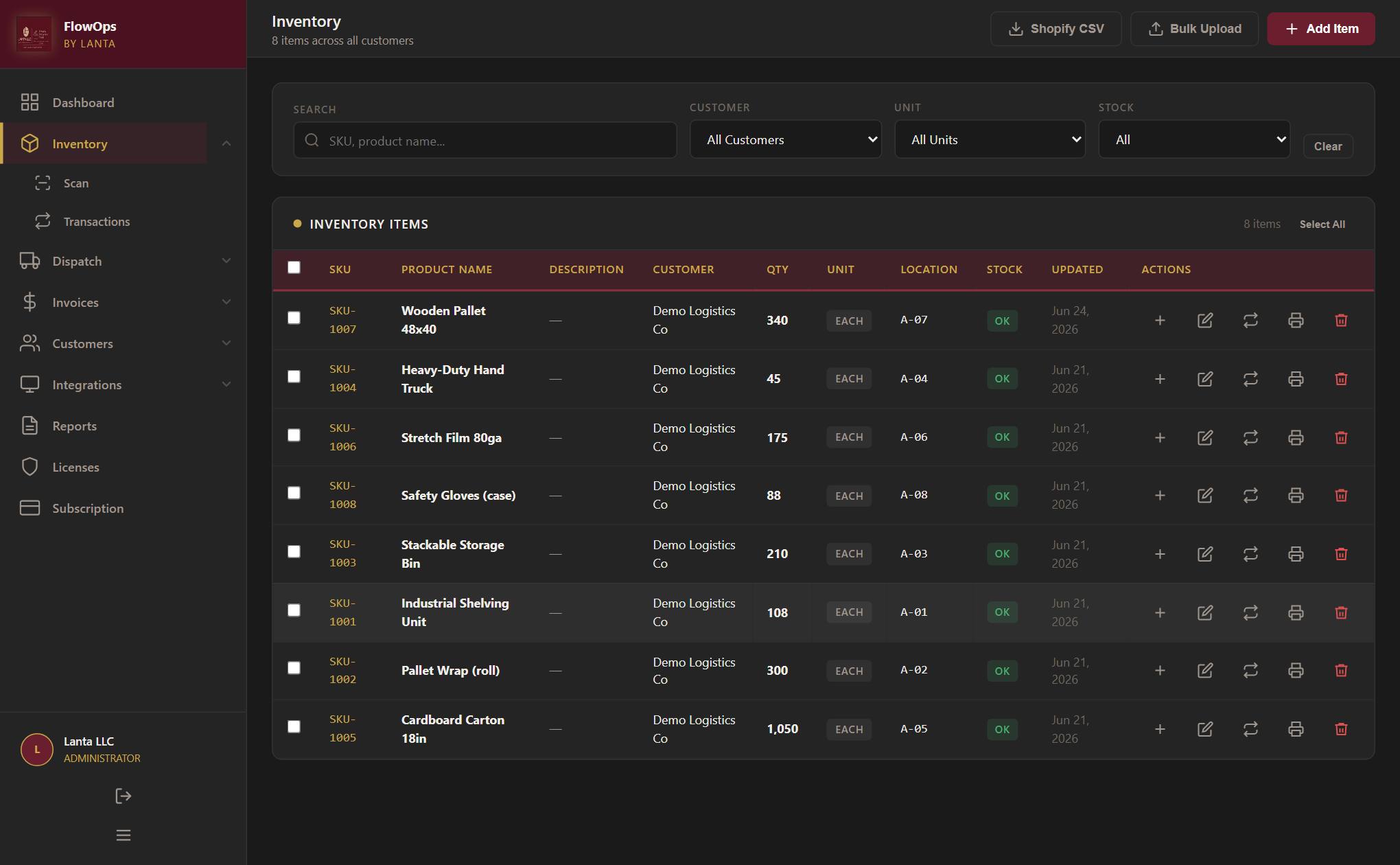
FlowOps includes 20+ modules, unlimited SKUs, and pricing starting at $99/month. Its patent-pending Agentic AI is designed to support operational decisions, while integrations help connect platforms such as Shopify, Amazon, and REST APIs.
How should brands evaluate a 3PL Maryland partner?
Evaluate supply chain management companies on facility capability, regional access, compliance, and measurable execution: not promises alone. Lanta Logistics provides Mid-Atlantic fulfillment from a Glen Burnie warehouse near Seagirt Marine Terminal, I-95, I-695, and BWI Airport, with capabilities for specialized products and coordinated transportation.

Food-grade warehouse with HACCP and FDA registration
Hazmat certified 3PL capabilities
SKU-level receiving and cycle counts
Transportation and final-mile coordination
Customer access to live operational data
DOT brake inspection and safety blitz compliance also matters. Carriers must maintain commercial vehicles systematically under FMCSA requirements, including applicable inspection, repair, and maintenance obligations in 49 CFR Part 396.
Choose Lanta Logistics for structured fulfillment execution, and explore FlowOps real-time visibility when your operation needs a more accountable technology foundation.
Comments